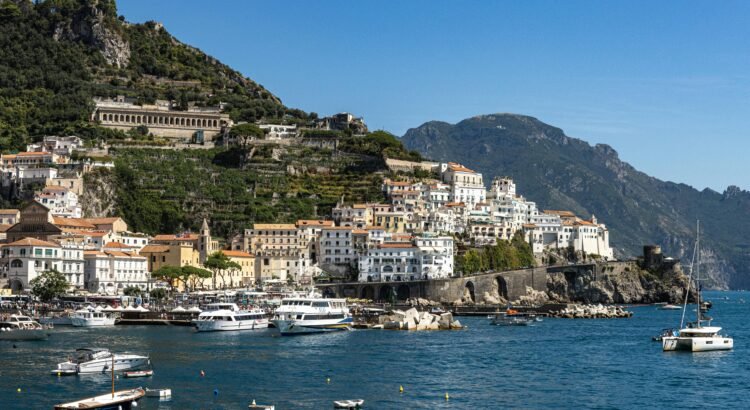
The Amalfi Coast, located along the Tyrrhenian coast of southern Italy, is one of the world’s most enchanting and visited coastal regions. Stretching from Positano to Vietri sul Mare, this coastline boasts a mesmerizing combination of natural beauty and cultural richness. Behind the coastline rise the Monti Lattari mountains, while the Gulf of Salerno stretches out before it, creating a spectacular setting. Renowned for its steep cliffs, hidden coves, and charming bays, the Amalfi Coast has long captivated travelers seeking both relaxation and adventure. Terraced hillsides adorned with citrus groves, vineyards, and olive trees add to the scenic charm, while artisan workshops and high-end boutiques contribute to its cosmopolitan appeal. Recognized as a UNESCO World Heritage site, the Amalfi Coast is celebrated as a quintessential Mediterranean landscape, seamlessly blending human creativity with nature’s splendor.
What is the Amalfi Coast and Where is it Located?
The Amalfi Coast extends between the Gulf of Naples and the Gulf of Salerno, encompassing sixteen picturesque towns in the province of Salerno. These include Amalfi, Atrani, Cava de’ Tirreni, Cetara, Conca dei Marini—home to the famous Grotta dello Smeraldo—Furore, Maiori, Minori, Praiano, Positano, Raito, Ravello, Sant’Egidio del Monte Albino, Scala, Tramonti, and Vietri sul Mare.
Despite the coast’s steep and rugged formation limiting the size of its beaches, the Amalfi Coast boasts some of the most breathtaking shorelines in the Tyrrhenian Sea. Tiny, pebbly beaches tucked between cliffs offer a unique charm, while natural caves along the coast provide a fascinating experience for visitors keen to explore hidden grottoes. Whether seeking relaxation or adventure, the Amalfi Coast’s combination of dramatic landscapes and pristine waters makes it an unforgettable destination.
History and Cultural Significance
The Amalfi Coast has a rich historical heritage that stretches back to Roman times. Evidence of Roman villas scattered along the coast indicates its ancient prominence as a residential area for the wealthy. During the Greek-Gothic Wars, local inhabitants allied with the Byzantines, gaining greater autonomy from the broader Roman Empire. Later, Amalfi came under the control of the Lombard principality of Salerno but soon rejoined the Byzantine Empire, preserving administrative independence.
Amalfi became the oldest of the Italian Maritime Republics, flourishing as a Duchy in the 10th century. Its greatest expansion occurred during the late 10th and early 11th centuries under Duke Manso I. However, after the Norman conquest in 1136, the region experienced economic decline. In subsequent centuries, Amalfi became the capital of its district within the Kingdom of the Two Sicilies before joining the unified Kingdom of Italy in 1861.
Why the Amalfi Coast is a UNESCO World Heritage Site
In 1997, the Amalfi Coast was designated a UNESCO World Heritage Site for its extraordinary cultural landscape, which exemplifies the harmonious relationship between humans and nature. The coast’s unique topography and historical evolution have preserved a landscape of remarkable natural beauty while integrating human activity in a sustainable way.
The region is characterized by Mediterranean vegetation, including maquis shrubland, forests, rocky cliffs, and terraced fields of citrus fruits and vineyards. Villages appear like tiny nativity scenes perched over the sea, with colorful houses, narrow streets, and tiled roofs creating an unforgettable visual impression. This blend of natural and cultural elements exemplifies why the Amalfi Coast is celebrated globally as a landscape of both ecological and historical importance.
Top Destinations on the Amalfi Coast
Positano
Positano, with its cascading colorful houses, narrow alleys, tiled rooftops, and steep staircases, is often the first stop for visitors. The town’s photogenic charm and vibrant streets make it ideal for exploring on foot, discovering local boutiques, cafes, and panoramic viewpoints overlooking the sea.
Amalfi
Amalfi, once a dominant trading hub in the Tyrrhenian region, features a townscape influenced by oriental architectural styles. Houses cling to steep slopes, while labyrinthine alleys and staircases wind through the town. The Amalfi Cathedral is a must-see, reflecting the town’s rich religious and cultural heritage.
Vietri sul Mare
Known as the “first pearl of the Amalfi Coast,” Vietri sul Mare captivates visitors with its alleys, colorful homes, artisan shops, and world-famous ceramics. The town’s charm lies in its combination of traditional craftsmanship and vibrant coastal scenery.
Cetara
Cetara, a small fishing village, offers a glimpse into a slower, more traditional way of life. Time seems to stand still in this charming town, where the rhythm of the sea and local traditions remain largely untouched by modernity.
Ravello and Villa Cimbrone
Ravello, home to the historic Villa Cimbrone, is a highlight for garden lovers and history enthusiasts alike. While the villa now operates as a private hotel, visitors can explore its expansive gardens and the famous Terrazza dell’Infinito, which offers breathtaking panoramic views of the Amalfi Coast.
Path of the Gods
For hiking enthusiasts, the Path of the Gods is a must-visit trail. This nine-kilometer route begins in Agerola and ends in Positano, offering spectacular views of cliffs, forests, and the sparkling Mediterranean below. The trail combines adventure, exercise, and incredible scenery in one unforgettable experience.
Culinary Delights of the Amalfi Coast
The Amalfi Coast’s culinary tradition is shaped by its fertile land, temperate climate, and proximity to the sea. Among the region’s signature products are Amalfi lemons, particularly the elongated Sfusato variety, which holds Protected Geographical Indication status.
Local wines are another highlight, ranging from crisp, fresh whites to robust reds and delicate rosés. Cetara is famous for its colatura di alici, a savory, amber-hued anchovy sauce that enhances pasta dishes. Traditional local specialties include ‘ndunderi, large semolina and ricotta gnocchi, which trace their origins back to Roman times. The coast’s cuisine reflects a blend of freshness, simplicity, and deep respect for local ingredients, making it a culinary paradise for travelers.
Conclusion
The Amalfi Coast is a destination where natural beauty, cultural history, and gastronomic delights converge. Its cliffs, coves, and terraced villages provide a stunning backdrop for exploration, while towns like Positano, Amalfi, and Ravello showcase centuries of architectural and historical richness. Whether hiking the Path of the Gods, savoring local cuisine, or admiring the vibrant ceramics of Vietri sul Mare, visitors to the Amalfi Coast experience a harmonious blend of nature and human creativity. Recognized by UNESCO for its exceptional landscape and cultural significance, the Amalfi Coast remains one of the world’s most beloved and timeless travel destinations.